



By Kris Osborn, President, Warrior
Most military observers and aerospace enthusiasts are quite familiar with the fact that the 1960s-era SR-71 Blackbird remains as the fastest known plane in existence. Available specs remain quite clear that indeed the SR-71 hit an unprecedented speed of Mach 3.2.
This fact remains quite staggering today to a certain extent, when one considers that the F-22 and Russian Su-35 max out in the Mach 2.2 to Mach 2.25 range. What technologies were so evolved all those decades ago such that an aircraft capable of Mach 3.2 could exist?
Sure enough, Lockheed is now building the often discussed SR-72 “Son of Blackbird” aircraft intended to fly at Mach 6, twice the speed of the SR-71. At Mach 6, the SR-72 will hit hypersonic speeds.
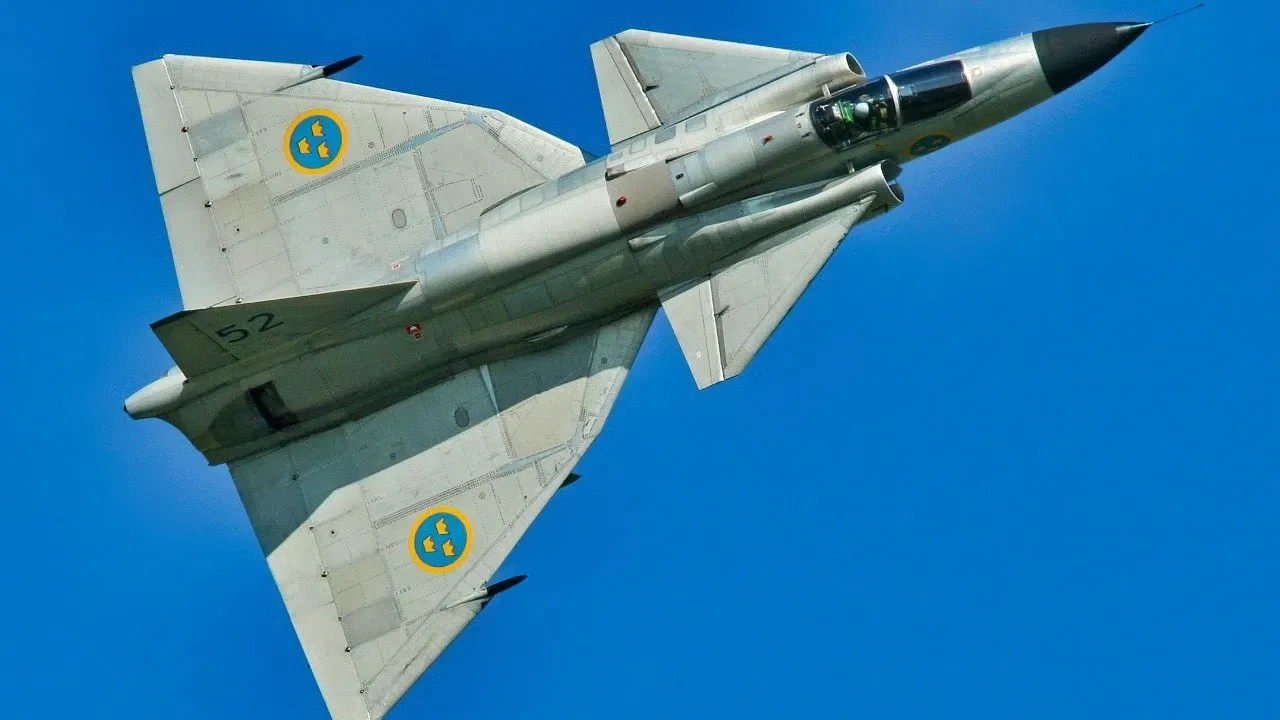
Much of this is known and widely discussed, yet there is a lesser known but quite astounding development which took place in the early 70s, not long after the SR-71 first emerged. The Saab 37 Viggen, a Swedish-built multi-role aircraft which reportedly was capable of hitting speeds of Mach 2.1. This is quite impressive, given that its first flight was in 1971, making it an aircraft which operated during the same timeframe as the SR-71. The Saab 37 appeared in many variants and operated as a fighter-bomber, reconnaissance aircraft, maritime patrol platform and air attack or “strike-fighter” role.
An ability to survey the ocean at those speeds, or conduct airstrikes at this point in history, likely made the aircraft extremely survivable.
Digital Central Computer
However, the Saab 37s speed was not the most impressive or defining element of the aircraft, as it was also the world’s first-of–its-kind digital central computer. Early computers were of course emerging at this time, yet what remarkably places the fighter decades ahead of its time is its computer automation. While likely far less advanced that current computer automation used across a wide variety of military platforms, the Saab 37 was engineered with technology automating tasks typically performed by pilots, according to an interesting write up in plane-encyclopedia.com
“Viggen incorporated the CK 37 (Centralkalkylator) computer, the first airborne computer with integrated circuits, This system would end integrating radar, air-defence screens (Stril 60), and computers, and the Viggen were intended to be the platform for such a system. This system made the aircraft extremely advanced in comparison to other designs,” the essay states.
F-35 Influence?
This migration from integrated radar to digital computer screens and air defense screens seems to indicate it may have been a decades-early “precursor” to the F-35s sensor-fusion. Sensor fusion is of course known as a pioneering technical effort to incorporate, organize and display incoming vital data on a single screen for pilots to view. This consolidated otherwise disparate sources or displays of incoming information and synthesized them in relation to one another. Could the Saab 37 have been the earliest iterations of this kind of approach? It seems feasible, as it is known as the first aircraft with a digital central computer.
The essay also introduces other extremely significant developmental reasons why the Saab 37 Viggen was ahead of its time. It pioneered an advanced datalink system the famous Swedish Gripen fighter jet could later incorporate. The Saab 37 was also capable of “short-take-off-and-landing,” something which one could say may have influenced the Harrier Jet or even the F-35B.
An interesting essay in The National Interest from 2024 says there was a point at which a Saab 37 Viggen successfully achieved a target lock on an SR-71 over the Baltic Sea. Perhaps this had something to do with the kind of computing and sensing now woven into the F-35.
Kris Osborn is the President of Warrior Maven – Center for Military Modernization. Osborn previously served at the Pentagon as a highly qualified expert in the Office of the Assistant Secretary of the Army—Acquisition, Logistics & Technology. Osborn has also worked as an anchor and on-air military specialist at national TV networks. He has appeared as a guest military expert on Fox News, MSNBC, The Military Channel, and The History Channel. He also has a Masters Degree in Comparative Literature from Columbia University.
