




by Kris Osborn, Warrior
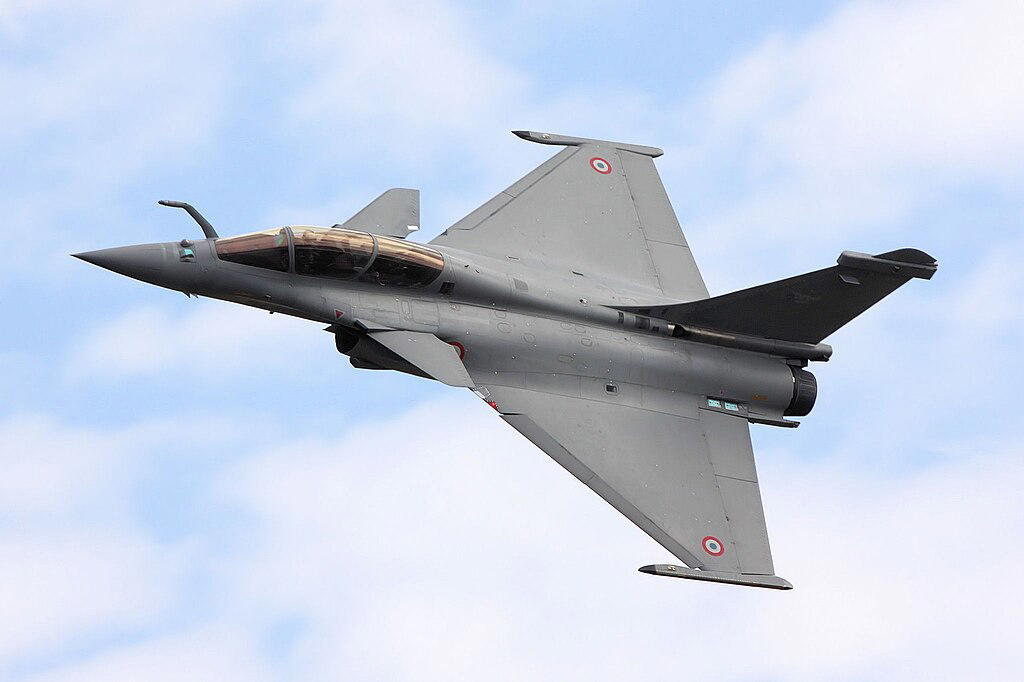
“Burst of Fire” and “Gust of Wind” are the literal terms for France’s popular Dussault Rafale 4-Gen “plus” twin engine fighter jet now used by nine countries, a quasi-stealthy smooth fighter able to hit speeds of Mach 1.8, fire a wide complement of weapons and launch from a carrier. The aircraft does have its own distinct look as it has two wings on each side, a semi smooth, rounded blended wing body and thin angular front section. Armed with French-built AESA Radar, infrared search and track, avionics and weapons systems, the Dussalt can carry air-dropped precision bombs, air-fired Storm Shadow missiles, air-to-air weapons and a nuclear-capable cruise missile called the ASMP-A.
International Dussault Rafale
While built by French companies Dussault Rafael, Thales and Safran, the fighter became quite successful as an international platform and is in service with India, Egypt, Qatar, Greece, Croatia, Indonesia, United Arab Emirates and Serbia. The aircraft, which has 14 hard points to carry a large arsenal of attack weapons, was used in combat over Afghanistan, Libya, Iraq and Syria. Unlike the multi-national European Typhoon, the French Dussault’s sensors, EW, avionics and weapons systems were all built entirely in the single country of France. The Dassault Rafale was originally part of a European teaming arrangement to build the Eurofighter, a multi-national collaborative effort which has now become the well known “Typhoon.” France, however, exited this UK, Italy, Spain Germany collaborative initiative and built its own Dussault fighter.
The upgraded Rafale aircraft is newer than many 4th-gen aircraft which emerged in the 1980s such as the F-15 and F-16, yet its continued relevance hinges upon the extent to which it has been upgraded. If the Dussault Rafael has been upgraded or undergone some type of modernization effort or Service Life Extension Plan, then it could indeed prove extremely worthwhile in conflicts against 4th-generation aircraft. There have been so many technological breakthroughs in the last 20 years that the Dussault Rafale would have to have received regular upgrades in order to compete in a modern threat environment. However, the French military has upgraded the Dassault Rafale and one essay in a publication known as Flying says the Rafale scored a “hit” on an F-35 in a simulated air-combat contingency entertained in the recently completed exercise called Atlantic Trident 25.
Dassault to Taiwan?
It seems clear that the Dassault multi-role fighter has delivered consistent and “solid” combat performances and is likely popular with international customers for a reason. This is likely why the suggestion that Taiwan might be interested in the Dussault is not likely to surprise anyone, although making that reality is a very complex and delicate question.
Dassault Aviation’s CEO Eric Trappier recently told the French National Assembly that indeed Taiwan is interested in the Dussault Rafale, according to an essay published by the Aviationist. Interest in the jet, however, is quite apart from making such a development a reality, given the geopolitical sensitivities such an idea is likely to generate between Taiwan and mainland China. However, Taiwan did acquire 60 Dassault Mirage 2000-5s in the 1990s so it does seem conceivable that upgraded Dassaults could make sense due to the fact that many of the Mirage 2000s are in need of maintenance, spare parts and large-scale modernization.
Adding Dassault Rafale’s could make sense for Taiwan as the country only operates some F-16s and Mirage 2000s, a circumstance which arguably leaves Taiwan vulnerable to quickly losing air superiority to a much larger and technologically superior PLA Air Force. Given China’s growing fleet of hundreds of 5th-Gen stealthy J-20s Taiwan and large fleet of 4th-Gen fighters, it seems Taiwan would need to rely upon US and allied F-35s to have any chance of slowing down a large-scale Chinese air invasion.
Kris Osborn is the President of Warrior Maven – Center for Military Modernization. Osborn previously served at the Pentagon as a highly qualified expert in the Office of the Assistant Secretary of the Army—Acquisition, Logistics & Technology. Osborn has also worked as an anchor and on-air military specialist at national TV networks. He has appeared as a guest military expert on Fox News, MSNBC, The Military Channel, and The History Channel. He also has a Masters Degree in Comparative Literature from Columbia University