



by Kris Osborn, Warrior President
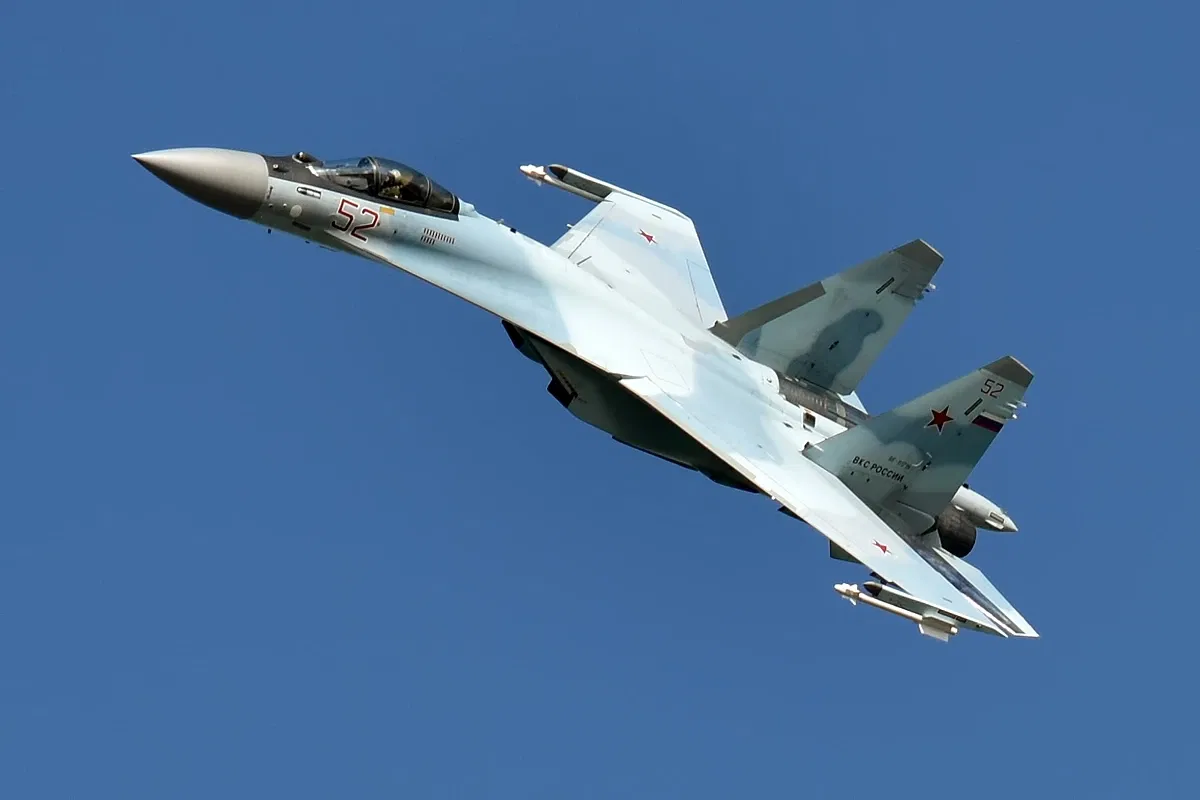
Russia’s Su-35 is an upgraded variant of the high-speed Su-27, and it has been integrated with an additional suite of upgrades intended to rival 5th-generation aircraft as a 4th-gen “plus” aircraft. The Su-35 can hit speeds of Mach 2.35 and operates with a “supercruise” capability similar to an F-22, meaning it can sustain Mach speeds without needing an afterburner.
These attributes may have contributed to a Chinese decision to buy 24 Su-35s from Russia in 2015 in a $2.5 billion deal, a development spelled out in a 2018 essay in the Diplomat. Following the initial deal, Russian Su-35s arrived in successive waves over subsequent years, and many speculated that indeed China would seek to re-engineer Su-35 technologies for use in its own, domestically-built fighter jets.
China became the first international customer of one of Russia’s most advanced fighter jets when it signed a $2.5 billion contract for 24 Su-35 fighter jets in November 2015. However, China did not appear to have actual interest in “flying” its acquired Su-35s but may have simply borrowed or “stole” the technology for its own growing air fleet. Acquiring then stealing more foreign foreign technologies is entirely consistent with China’s widely observed modernization tactics, yet it may not be clear if engineering details learned from acquiring and Su-35 can truly be reverse-engineered and replicated for Chinese fighters.
A significant essay in 1945 from February 2025 refers to China’s well known and heavily documented efforts to copy or steal foreign technologies, and it may not surprise anyone to observe that China’s J-11 4th-generation fighter emerged shortly after China had acquired the Russian Su-27. This may not be a coincidence the 1945 essay explains, as acquiring Su-35s could simply be more modern variation of this kind of technology
Stealing Russian Technologies?
What kinds of Su-35 technologies might China be interested in? The PRC does have a history of domestically engineering its own versions of advanced foreign technologies; in recent years, the PLA Air Force built its own indigenous WS-15 engine for its J-20 as a replacement for previous Russian engines. It would therefore make sense that perhaps China simply wanted to “study” and learn about Russian avionics and fighter-jet technologies.
For instance, an interesting and potentially lesser-recognized factor is that the Su-35, while not a fully stealth aircraft, does appear to have some radar-cross-section reducing attributes. Simply to the observer's eye, the Su-35 does look a little stealthy, as it has a slightly more rounded fuselage than most more sharply-edged 4th-generation aircraft. A blended wing-body presents fewer sharp contours and angles likely to generate a return rendering to enemy radar when electromagnetic “pings” bounce off the aircraft. Looking closely at the fuselage, the Su-35 does seem to slightly resemble the F-22, yet that by no means indicates its stealth properties are comparable.
The Su-35 did, however, arrive as recently at 2014, a timeframe suggesting that the aircraft may indeed incorporate a large number of more cutting-edge upgrades in the realm of weaponry, sensing, avionics, mission systems and non-kinetic weapons such as EW. Some newer technologies might contribute to the Su-35s high 1.30 thrust to weight ratio.
An interesting essay in The Diplomat further elaborates on some of the advanced technologies woven into the Su-35.
“The Su-35 is an upgraded fourth generation, twin-engine, multirole air superiority fighter aircraft powered by two AL-117S turbofan engines and fitted with thrust vectoring nozzles allowing the aircraft to attain “super maneuverability”. Additionally, the aircraft features “an export-standard radar system — the Irbis-E passive-electronically scanned-array radar, capable of tracking up to 30 targets simultaneously and purportedly able to engage up to eight — an electronic warfare and communications suite, as well as a newly integrated receiver for the domestically-built BeiDou satellite navigation system,” the essay says.
Acquiring then stealing more foreign foreign technologies is entirely consistent with China’s widely observed modernization tactics, yet it may not be clear if engineering details learned from acquiring and Su-35 can truly be reverse-engineered and replicated for Chinese fighters.
Kris Osborn is the Military Technology Editor of 19FortyFive and President of Warrior Maven – Center for Military Modernization. Osborn previously served at the Pentagon as a highly qualified expert in the Office of the Assistant Secretary of the Army—Acquisition, Logistics & Technology. Osborn has also worked as an anchor and on-air military specialist at national TV networks. He has appeared as a guest military expert on Fox News, MSNBC, The Military Channel, and The History Channel. He also has a Masters Degree in Comparative Literature from Columbia University
