



By Kris Osborn, Warrior
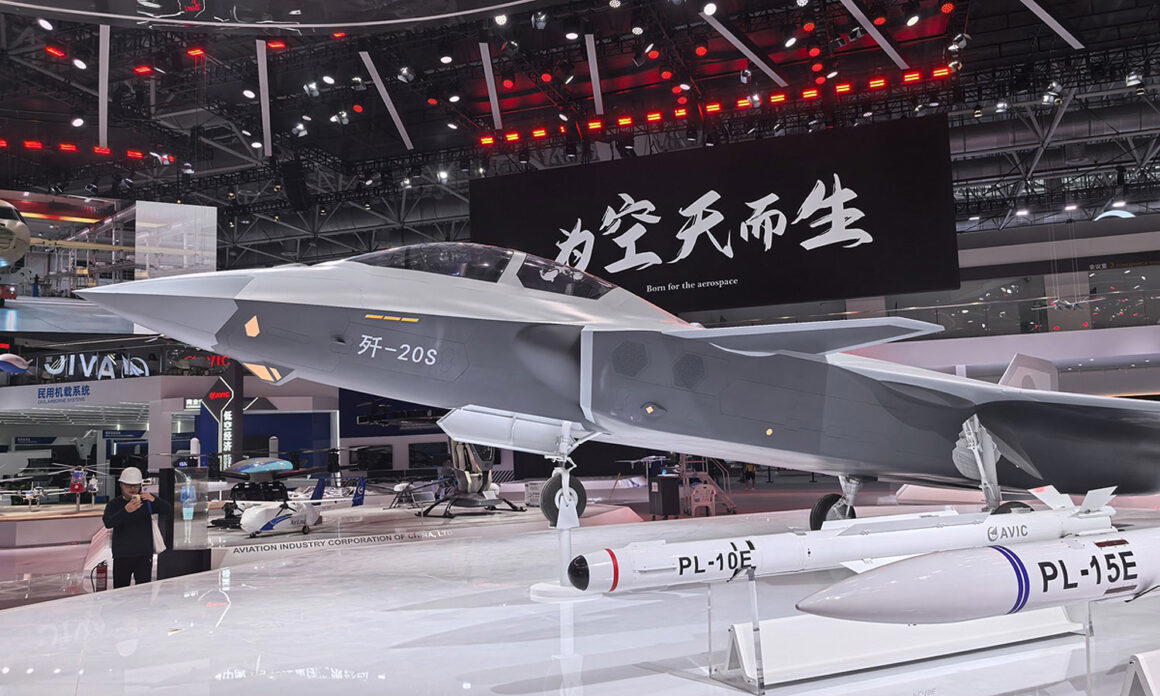
(Washington, DC) China’s publicly displayed J-20S is the first-ever-to-exist twin-seat stealth aircraft, something defining as a historical marker, yet the addition of a second “seat” in the famous J-20 Mighty Dragon raises significant new questions about PRC military Concepts of Operation.
The most immediate and self-evident observation might simply be that the PLA greatly values human insight and decision-making in air combat. Given the PRCs emphasis upon AI, and the ability of an AI-empowered threat to defeat a human pilot in simulated dogfights, the addition of a second human to the J-20 tells us something about Chinese thinking when it comes to AI vs. human cognition in the realm of high-speed combat decision making.
Clearly the creation of the J-20S involved some tradeoffs, as a two-seat stealth fighter naturally weighs more and is not likely to be as fast or maneuverable. The second seat, however, might better enable high-speed command and control, weapons targeting, radar technological program and threat tracking mission.
Chinese View on AI
Knowing how fast and how capable AI-empowered fighter jet operations are, why would the PLA AF add a second human to its stealth fighter? Perhaps PLA decision-makers have a view somewhat similar to the United States when it comes to fully autonomous AI-driven operations? The Pentagon believes that the optimal approach is to blend the two through “human-machine-interface” in order to leverage optimal characteristics of each and blend them together in support of one another.
This approach would suggest that the Chinese, much like the Pentagon, believe there are attributes and characteristics unique to human cognition and consciousness which cannot be replicated by mathematically-generated algorithms. It would be accurate to say that this is the consensus or prevailing viewpoint at the Pentagon, meaning weapons developers do not support the use of AI-enabled autonomous lethal force. Rather combat effectiveness is optimized when AI-enabled computing and human decision-making faculties operate in close coordination with one another.
AI-enabled Copilot
The US Air Force Research Laboratory has taken this man-machine blending to a new level with an experimental program designed to “optimize” the best combination of human and AI-empowered capabilities by placing an AI-copilot in a fighter jet to support a human pilot. The concept is to lessen the cognitive load on a pilot by performing many of the procedural functions with a high-speed, AI-enabled computer supporting a human decision maker. The AI copilot used for the AFRL experiment was called Artuu, and the service sought to harness lessons learned from the test operations.
What then are the advantages of a twin-seat J-20? The first and most pressing of which would seem to pertain to drone controls, manned-unmanned teaming and the use of a “loyal wingman” drone. This means the two-seat stealth fighter could operate like a small, fast, stealthy flying command and control hub operating drones, conducting targeting and maintaining multi-domain battlefield awareness.
Kris Osborn is the President of Warrior Maven – Center for Military Modernization. Osborn previously served at the Pentagon as a highly qualified expert in the Office of the Assistant Secretary of the Army—Acquisition, Logistics & Technology. Osborn has also worked as an anchor and on-air military specialist at national TV networks. He has appeared as a guest military expert on Fox News, MSNBC, The Military Channel, and The History Channel. He also has a Masters Degree in Comparative Literature from Columbia University
