

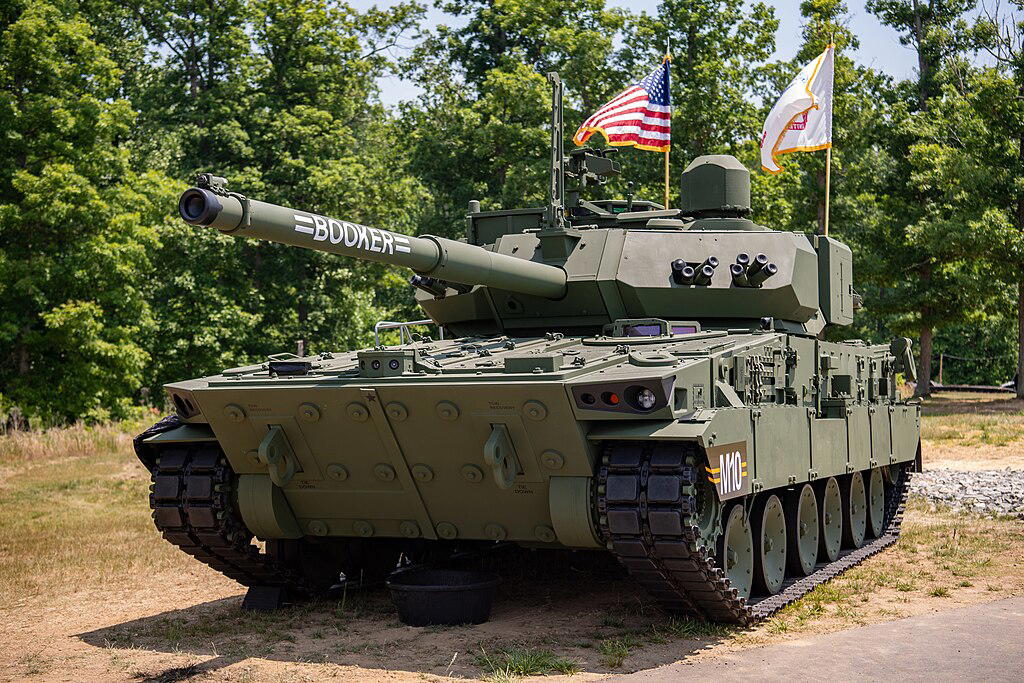


Airdrop dreams shattered. The M10 Booker, designed for rapid infantry support, ironically became too heavy for its intended airborne deployment.
by Kris Osborn, Warrior
At its inception, the now-cancelled US Army M10 Booker or Mobile Protected Firepower vehicle was intended to bring lethality and firepower to the Infantry Brigade Combat Team in a way that heavier vehicles such as the 70-ton Abrams tank simply could not. The idea was to engineer a high-speed, lighter yet extremely lethal armored vehicle to air drop from cargo planes and provide offensive fires for infantry on the move. This was the key requirement, particularly because the large Abrams tank is not only difficult to deploy but also has significant mobility restrictions in the realm of driving over bridges and other narrowly configured areas;
While the Army did not want to call the Booker a “light tank,” it was designed to do what the Abrams tank could not. The Abrams has trouble keeping pace and maneuvering with dismounted infantry which regularly needs to move quickly through uneven and challenging terrain and more condensed urban areas.
Apart from the high-speed, lethal maneuver, the M10 Booker was intended to align with the Army’s intense and growing emphasis on expeditionary operations. Certainly, the Abrams has what many see as an enduring place within the Army’s future arsenal, yet 70-ton tanks are tough to deploy. The Abrams often need to travel by boat and spend weeks “staging” on location for proper maintenance and logistical support. The M10 Booker, however, was intended to literally “airdrop” quickly from a C-17 cargo plane in support of fast-attacking infantry. However, the Army’s ambitious vision for the M10 Booker wound up colliding with practical reality, and the final platform was too heavy to be airdropped. This predicament, which was completely at odds with the initial requirement for the vehicle, is cited as the main reason why the vehicle was cancelled.
“We got a heavy tank,” Army Secretary Dan Driscoll was quoted saying in an essay published in ClearanceJobs.com
True Expeditionary Weapons
Armored expeditionary tactics are increasingly critical as warfare becomes much faster, networked, and multi-domain. For example, an ability to deploy quickly meant, in terms of Concepts of Operation, that groups of M10 Bookers could support high-speed amphibious attacks into islands in the South China Sea or heavily contested coastal areas.
Perhaps of most tremendous significance, the Army prioritized and intensely pursued the ability of the vehicle to airdrop from a cargo plane. The idea was to engineer the M10 Booker the ability to operate in close support of airborne operations and bring organic heavy fire support to air-dropped “forcible entry” missions to seize enemy territory from the air. This is likely why the Army previously planned to first deploy the M10 Booker with the 82nd Airborne unit in 2025. This vision crashed into a different reality when the Army recognized that the 38-ton M10 Booker was simply too heavy to air drop from a C-130 and that only one could fit into a C-17.
The M10 Booker was intended to address a growing tactical deficit, given that warfare is becoming much faster, more networked, and multi-domain. Advancing infantry need supportive fires to breach an enemy perimeter or advance into occupied urban areas. It seems the problem was that, in order to make it survivable enough to be “manned,” the Booker simply got too heavy to align with its intended requirements.
Unmanned Vehicles
The rapid emergence of advanced, AI-enabled autonomy was also likely a key factor in the decision not to go forward with the vehicle, as its missions could be easily performed in an unmanned robotic vehicle which was much lighter, more deployable, networked and capable of supporting larger manned platforms such as an Abrams. The concept is quite analogous to what could be called a “ground” version of the well-known aerial “loyal wingman.” High speed, maneuverable supportive fires can exist in the form of more attritable, lightweight armed robotic vehicles able to deliver suppressive fires, conduct forward attacks and sling load beneath a Chinook or C-130.
Kris Osborn is the President of Warrior Maven – Center for Military Modernization. Osborn previously served at the Pentagon as a highly qualified expert in the Office of the Assistant Secretary of the Army—Acquisition, Logistics & Technology. Osborn has also worked as an anchor and on-air military specialist at national TV networks. He has appeared as a guest military expert on Fox News, MSNBC, The Military Channel, and The History Channel. He also has a Masters Degree in Comparative Literature from Columbia University
