



Unparalleled stealth, Mach 2 speeds, and advanced drone control define the revolutionary F-47, potentially redefining aerial combat supremacy.
By Kris Osborn, Warrior
Stealth, speed, dog-fighting prowess, long-range weapons delivery, controlling drones from the cockpit and operating as a flying sensor “node” or command and control center … in the air … are just a few of the key attributes likely associated with the emerging 6th-Gen F-47.
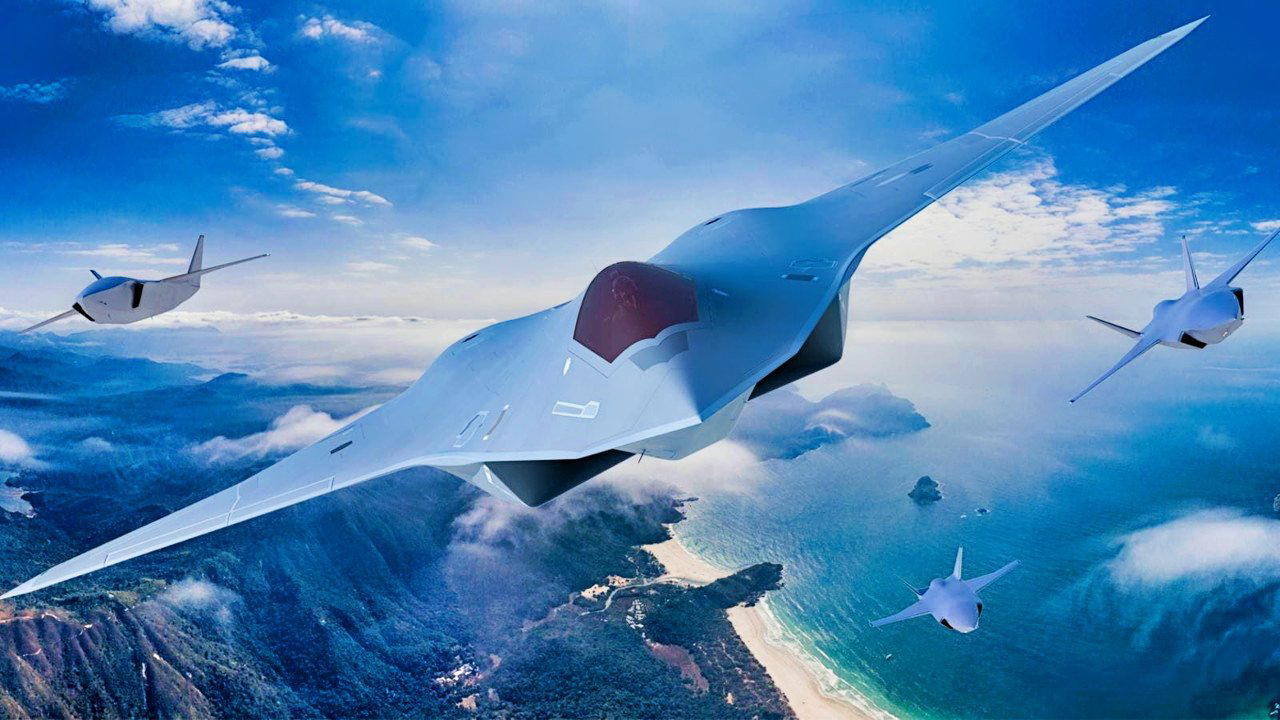
Developers have likely been seeking an optimal balance between full, broadband stealth, pure speed and aerial agility, fortified with what may be paradigm-changing breakthroughs in the realm of fighter jet vectoring, thermal management, thrust and radar signature reducing properties. A simple observer’s eye assessment of the fuselage indicates a potential breakthrough of paradigm-changing proportions, as the configuration would seem to indicate the F-47 has achieved a bomber-like blended wing body with a smooth, rounded horizontal blended wing body.
Stealth Supremacy
The absence of vertical structures would seem to suggest that weapons developers and cutting edge innovators have found a way to combine bomber-like stealth with fighter-jet-like speed and agility. There are no protruding structures or sharp angles or edges off of which an electromagnetic “ping” might bounce off to generate a return rendering, so ground radar is naturally more challenged to develop a shape, size, speed or flight-path of the F-47. This means potential enemies will … as mentioned by President Trump … “never see it coming.” That certainly is the idea with the aircraft, which is publicly said to be capable of Mach 2 speeds and nearly double the range of an F-35 or F-22. Stealth performance is also fortified by special rubber-like coatings and radar absorbent composite materials designed to “absorb” rather than bounce-back an electromagnetic ping from enemy radar. The concept, as explained in the case of a B-2 bomber, is to generate a circumstance wherein the stealth aircraft appears like a small “bird” to enemy radar.
Future of Dogfighting
While the F-47 is almost certainly being built with a mind to establishing F-22-like air supremacy by leveraging advanced dogfighting ability, thrust-vector technology and an exemplary thrust-to-weight ratio, the irony is new generations of sensing technology may begin to make dogfighting somewhat obsolete. While there will always be a need to prevail in the “close-in-fight” when it comes to air combat, high-fidely long-range targeting, highly sensitive and powerful AESA radar, new generations of targeting sensors and AI-enabled computing may translate into a solution wherein fighter jets can prevail without needing to operate within striking range of an adversary aircraft. These variables are changing as well also, given that air-to-air weapons such as the PLAs JL-15 and the US Air Force-Navy AIM 260 are now bringing much longer air-to-air attack reach. However, the possibility of a range-detection disparity may ultimately prove to be a more decisive variable regarding who prevails in air-to-air combat. This is certainly the case with the F-35, as US Air Force Red Flag wargames have shown that the F-35 can “see” and “destroy” 4th-generation aircraft at ranges from which it cannot itself be detected. The F-47 will need both unparalleled long-range, high-resolution sensing as well as air-to-air and air to ground precision weapons hardened against jamming and able to “outrange” enemy weapons.
Heat Signature
The F-47 is almost certain to be on the pioneering edge of thermal management, meaning an internally buried engine, coupled with exhaust emission controls, cooling technologies and IR suppressors or heat reducing technologies are all likely to factor prominently. The idea is to ensure that the aircraft itself operates at roughly the same temperature as the surrounding atmosphere, so as to prevent IR sensors and heat-seeking weapons guidance systems from detecting an actionable “heat” signature from the aircraft.
Loyal Wingman
Perhaps most of all, the F-47 will need to leverage unparalleled AI-enabled computing, sensing and command and control; the faster and more securely an integrated on-board computer system can gather, organize and analyze incoming data from otherwise incompatible transport layers and sensors .. the more lethal it will be. Getting ahead of or inside of an enemy’s decision making process or “OODA” Loop as famously described by Boyd, will enable the F-47 to see first, verify first, shoot first and kill first .. meaning advanced analytics can perform target acquisition, verification and sensor-to-shooter pairing through fire control, faster than an adversary. This airborne AI can perform time-sensitive analytics at the point of collection and further expedite high-speed decision-making in combat; this is the same breakthrough computing and command and control which will enable the F-47 to control the flight path and payload of multiple drones from the cockpit. This means that a manned F-47 can operate at a safe, standoff distance while operating forward drones and Combat Collaborative Aircraft in position to penetrate contested areas, test, jam or attack enemy air defenses and function as a multi-domain aerial sensor “node” in position to form a combat “cloud” or air-sea-land-space combat network.
Kris Osborn is the President of Warrior Maven – Center for Military Modernization. Osborn previously served at the Pentagon as a highly qualified expert in the Office of the Assistant Secretary of the Army—Acquisition, Logistics & Technology. Osborn has also worked as an anchor and on-air military specialist at national TV networks. He has appeared as a guest military expert on Fox News, MSNBC, The Military Channel, and The History Channel. He also has a Masters Degree in Comparative Literature from Columbia University
