


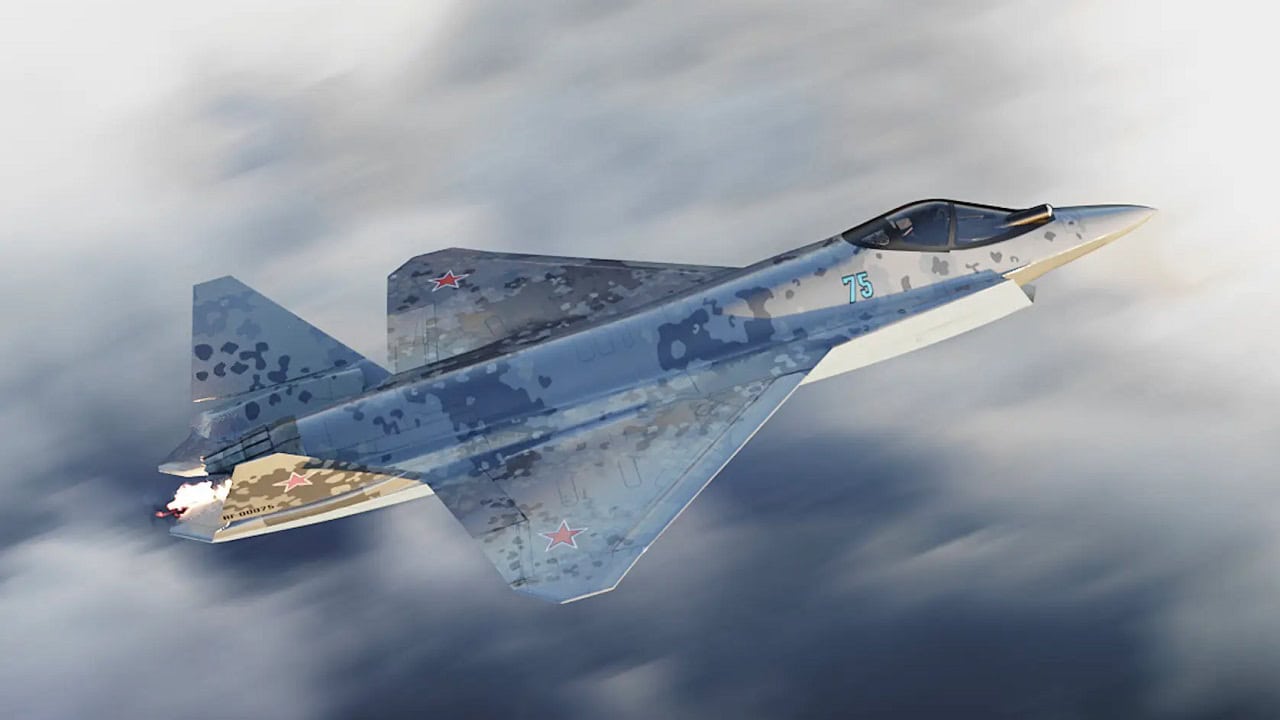



Russia's Checkmate fighter: a low-cost F-35 copy? Unveiling its true capabilities, stealth, and networked warfare potential reveals more questions than answers.
By Kris Osborn, Warrior
There appears to be more questions than answers related to Russia’s emerging 5th-gen Su-75 “Checkmate” stealth fighter, because despite renderings of its external configuration, very little seems to be known about its sensing, computing, fire control and weapons. Attributes less visible to the eye are likely to prove more defining and impactful than an external stealth structure.
Much like an F-35, the Su-75 Checkmate is a single-engine blended wing body with two vertical F-35-like tails. The shape of the fighter does look stealthy, and many speculate that perhaps Russia is trying to engineer a low-cost F-35 competitor to sell on the international market. It's unclear how much the new fighter would cost and what kinds of Russian allies or customers might purchase the fighter.
It seems conceivable that Russia may seek to build a 5th-generation airpower “counter” to NATO by mass producing an expensive F-35-like stealth fighter. However, such an effort is arguably too ambitious given how far a pro-Russian Su-75 alliance would need to go to catch the hundreds of F-35s now surging across as many as 18 countries. Furthermore, it seems unlikely that the Su-75 would operate with an F-35 like multi-national datalink. All F-35s can seamlessly exchange targeting and intelligence data across combat formations using a common Multi-Function Advanced DataLink (MADL). Could allied “chedkmate” Su-75 countries operate with a similar secure command and control multi-national networking technology?
Also, apart from sensing and information sharing, the Su-75 is likely to encounter budgeting and production problems, much like Russia’s Su-57.
How stealthy is the Su-75?
External configuration is but one element of stealth technology, meaning it can reduce radar signature by virtue of having few protruding structures or sharp angled configurations more likely to generate a radar return signal. However, while it can help direct air flow for vectoring and greatly decrease radar cross section, external configuration is but one element of a stealth configuration. Does it have radar absorbent materials? How is it bolted and seamed in terms of connected joined elements of the fuselage? Of equal importance are questions about its thermal signature. The back end has been tough to see with available photos, although the aircraft does certainly have an internally buried engine likely optimized for low heat emissions.
The Su-75 does appear to have an internal weapons bay, yet the quantity and composition of its arsenal, as well as its max payload weight, are not likely to compete with an F-35. Available specs of the Su-75 say it has an F-35-like max take-off weight of 26,000 pounds, speeds up to Mach 1.8 and advanced Infrared Search and Track targeting technology. An operative question here clearly relates to the range, accuracy and resolution of its sensing, as the aircraft is unlikely to rival the sensing capacity of the F-35, an aircraft which has shown in wargames to be capable of “seeing” and “destroying” groups of 4th-gen aircraft from ranges where it cannot itself be detected. The Checkmate does have a different configuration than Russia’s existing Su-57, a stealthy aircraft purported by Russian developers to be a 5th-generation platform.
Should the F-35, Su-57 or new Russian fighter be similar in performance ability to any degree, the superior force may simply be which country has more high-end, 5th-generation aircraft. In this respect, the U.S. seems to have a clear advantage. Globalfirepower.com says the U.S. operates 1,956 fighters/interceptors and is of course known to be moving quickly to add large numbers of F-35s. By contrast, the same assessment reports in its 2021 rankings that Russia only 789 fighters/interceptors, just more than one-third the U.S. number.
If one of the aircraft were far superior to the other in terms of targeting range, weapons reach and guidance or computing and EW, numbers might not be as crucial. However, should they be in any way comparable, the force with larger numbers will be more likely to win a war of attrition, outlast the other and cover wide areas of combat space an opponent could not defend.
Kris Osborn is the President of Warrior Maven – Center for Military Modernization. Osborn previously served at the Pentagon as a highly qualified expert in the Office of the Assistant Secretary of the Army—Acquisition, Logistics & Technology. Osborn has also worked as an anchor and on-air military specialist at national TV networks. He has appeared as a guest military expert on Fox News, MSNBC, The Military Channel, and The History Channel. He also has a Masters Degree in Comparative Literature from Columbia University.