

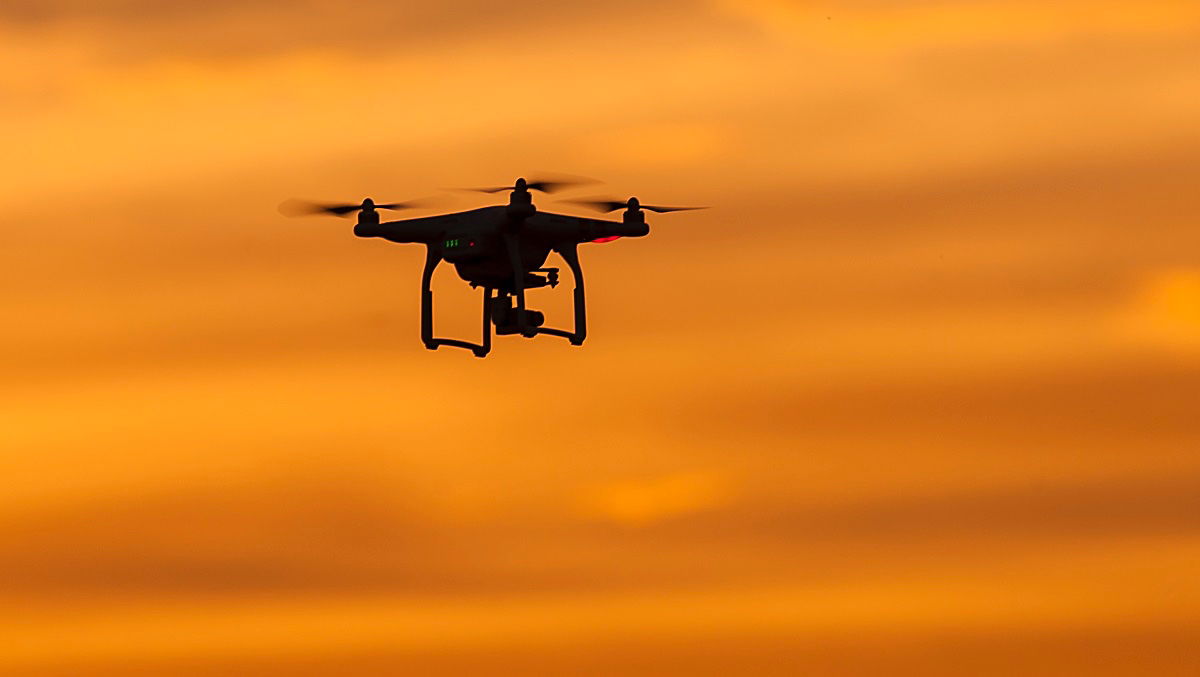
Pentagon Develops AI-Enabled Drones to Enter Windows, Blast Through Doors and Find Targets


by Kris Osborn, Warrior President
Autonomously entering windows, opening doors and networking across multiple aerial nodes in real time to exchange targeting information and, with human direction, attack targets are a few of the missions AI-enabled drones are increasingly capable of performing.
The Pentagon is fast-tracking AI-empowered robotics, and in part through a new, collaborative deal with XTEND, they are breaking through on the cutting edge of AI-capable robotics.
Advanced algorithms enabling collective information gathering, analysis and streamlined networking are now enabling groups of drones to perform a much wider range of tasks autonomously without needing human intervention.
Aviv Shapira, CEO of XTEND, says: “Our next generation technology supports our strategic partners in the recent unfolding events with cutting-edge new types of warfare capabilities. XTEND’s Remotely operated AI loitering munition system delivers precision, lethality, and true over-the-horizon effectiveness, empowering forces to engage threats with unmatched accuracy and control — from across the globe.”
"Let's say I have three drones in front of me, and I'm telling drone number one, you scan the first building, drone number two, you stay above me and watch my back, drone number three, come on, we're going inside the building. This what we're doing...... we are providing allied forces with AI teammates. How can you use AI to support your mission and make you more effective." Shapira, told Warrior in an interview.
The early days of autonomy relied upon GPS way points which simply identified a fixed specific location toward which an unmanned system would independently travel in the air or on the ground, a method of autonomy operating in a linear, more narrowly focused capacity. Following the advent of simple autonomy, the integration of AI increased the functionality of robotic systems by enabling forward analysis, discernment and decision-making closer to the point of collection.
More modern, AI-enabled autonomy consists of ways forward operating unmanned systems can collect information, perform analytics bouncing things off a database and autonomously make operational determinations in milliseconds. This requires tagging data, training systems, and enabling high-speed, close-to-real-time data analytics.
"We're training AI pilots to fly different types of missions. For example, we're training a drone to breach a building. The drone needs to understand how to approach to the door or the window, place a charging device, and open that window or door," Shapira said.
Robots, drones and AI-enabled unmanned systems have been in existence for several years now, as evidenced by the recent Ukrainian drone attack on Russian bombers using AI-capable drones, yet the Pentagon and XTEND are pushing the envelope further to increase the scope of autonomous functions performed by AI Robotics forces.
Shapira was clear to emphasize critical ethical parameters fundamental to their concepts of operation guiding use of AI-capable drones, meaning a human will always remain "in the loop" when it comes to the use of lethal force. "Supervised, human-guided autonomy" is the term Shapira used in a discussion with Warrior, a term to describe the strategy thinking and human-machine interface that remain fundamental to successful autonomous operations.
"I can tell you that we have used AI for munition attack missions, but humans were always in the loop supervising. What we can do is get to that threat, get to that person, and then ask the human supervisor, hey, is this a target? Can I move forward? Can I complete the mission? ..... searching for that target, getting to that building, getting inside the building, you know, even breaching the building is made possible by AI" Shapira explained. "As long as you're not counting only on AI on its own to finish the mission, we are good."
The effort is very much in the early phases, Shapira explained, as XTEND intends to program as many as 40-different AI pilots by the end of 2025 to expand the operational envelope of possibility.
Gateways
As part of the effort to enable multi-dimensional, collective information processing, XTEND is working to engineer a soldier-wearable computer able to operate as a gateway or essential "translator" between pools of data arriving from different sensors and transport layers.
"We call it Combat AI, so it's a computer that the soldier wears on his back or on his front. It has all the right gateways to interface between all the data screens that connect......so I can connect to a satellite. I can connect to ATAK, and I can connect to four drones. Combat AI integrates all these channels into one place in order to make decisions," Shapira explained.
This kind of system is of great tactical significance, given that different transport layers such as RF, GPS and other wireless datalinks operate with different protocols and technical configuration, so an advanced system engineered with interfaces sufficient to gather and "integrate" otherwise incompatible streams of data --- can massively streamline operational efficiency.
Overall, XTEND's approach seems to align with the Pentagon's focus on human-machine teaming, meaning that the optimal approach to integrating AI should include a merging or combination of both human and machine input.
"As long as you have a human in the loop to abort the mission, we should be good as well. Fortunately for us, the good guys, us and our allied countries, of course, are using AI very, very slowly and responsibly I would say. We're learning this field," Shapira said.
Kris Osborn is the President of Warrior Maven – Center for Military Modernization. Osborn previously served at the Pentagon as a Highly Qualified Expert with the Office of the Assistant Secretary of the Army—Acquisition, Logistics & Technology. Osborn has also worked as an anchor and on-air military specialist at national TV networks. He has appeared as a guest military expert on Fox News, MSNBC, The Military Channel, and The History Channel. He also has a Masters Degree in Comparative Literature from Columbia University.
