

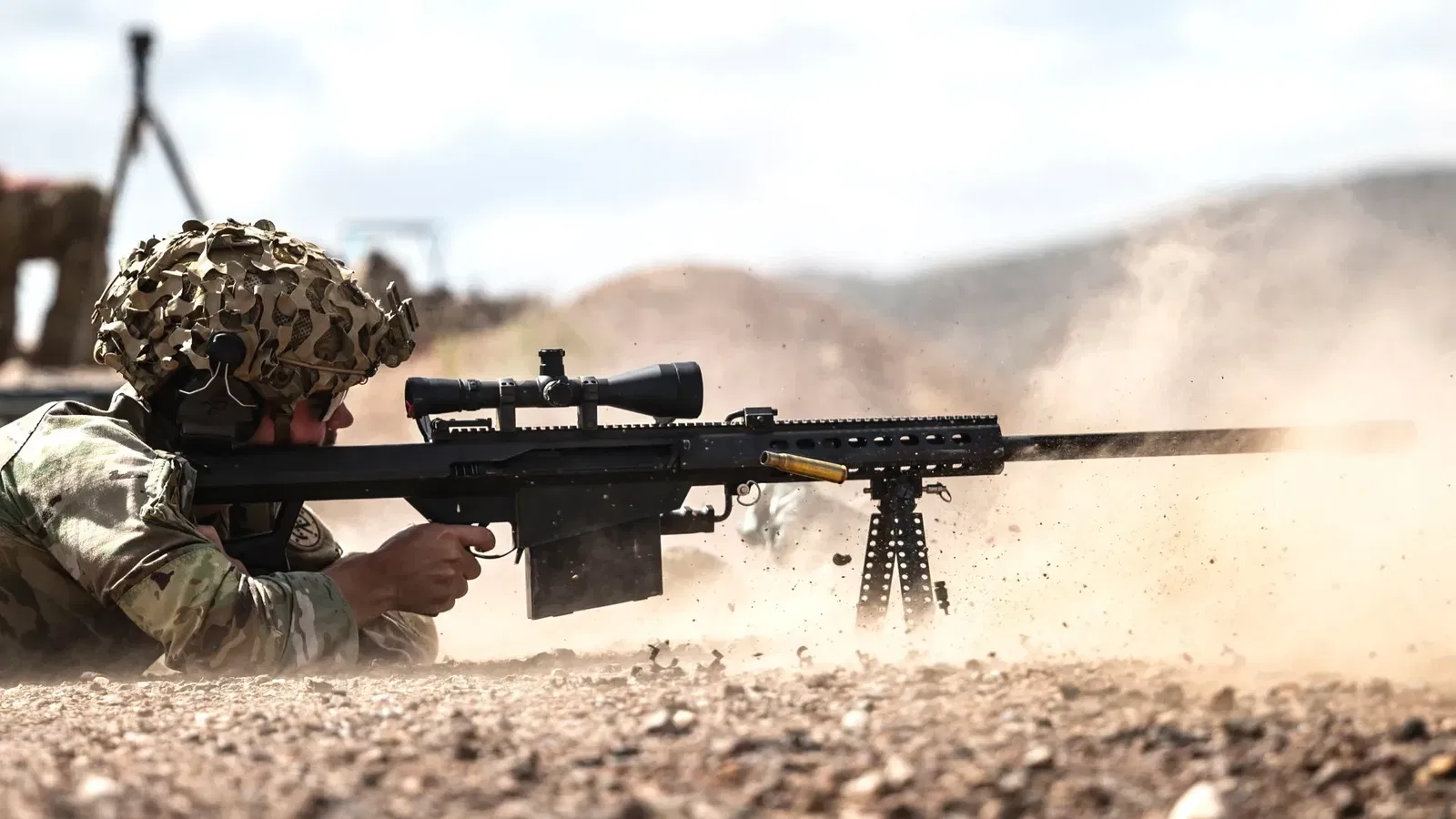
How Warriors Fire a .50-cal Sniper Rifle


by Kris Osborn, Warrior President
The Barrett M107A1 is considered a large sniper rifle which fires a .50-cal bullet. The larger bullet can, of course, destroy an individual enemy fighter, yet the .50-cal sniper bullet is primarily designed to destroy or disable thin-skinned enemy vehicles and small structures or fortifications. As one former Army weapons expert explained it to me, the M107A1 is the kind of weapon which could be used to hit, destroy or disable the engine of an enemy vehicle.
The M107A1 is nearly five-feet long at “57 inches, with a cylinder-like suppressor at the end and a weight of about 28-pounds. Barrett has been under contract to deliver M107A1 .50-Cal Long Range Sniper Rifle systems to the US Army in an $8 million deal which includes scopes, suppressors and square parts kits. Barrett information on the gun specifies having a "lightweight aluminum upper receiver with integral optics" Barrett data further describes the weapon as having a "barrel with fully chrome-lined chamber and bore, 10-round steel magazine with cartridge witness indicators and anti-corrosive coating."
Information from Military.com says the rifle is a commercial weapon that incorporates a dual chamber detachable muzzle brake, dual barrel springs and long mainspring design to reduce the weapon’s recoil.
The M107 uses a variable power day sight and a 10-round detachable box magazine. The rifle weighs 35 pounds fully loaded and includes folding front and rear sights, a fluted match-grade barrel, detachable carrying handle, rubber recoil pad, rear grips and a Picatinny rail.
I fired the M107 Sniper Rifle
While attending the Bushmaster User Conference in Northern Arizona 2019, sponsored by Bushmaster cannon-maker Northrop Grumman, I had the opportunity to attempt to fire M107.
While being closely coached by an expert sniper from Barrett, the gun’s maker, I attempted to align my eye directly through the scope in a direct, linear fashion. I found that if my view shifted ever so slightly from one side to the other, I lost the target picture and saw only black. This, I understand, is a technical design set up to deliberately ensure the person looking through the scope can only see if he or she is exactly aligned with a straight-ahead view at the target.
Then, while being instructed by the expert, I struggled to line up what looked like a thin black cross targeting line, or “reticle” through the scope - with a small blue target circle hidden between bushes in a desert firing range about 200-yards away. The targeting scope itself, shows what looks like a narrowly configured, intensely magnified picture of a circular area of terrain ahead, with a reticle crossing straight through the eye view. The intent, as I understood, is to precisely align the center of the cross with the intended target and pull the trigger -- to achieve precision destruction. Snipers rotate a small circular device attached to the weapon's sight - and "click" one way or another - as it is called - to align the crosshairs with the target and adjust the reticle for wind, range or elevation changes.
Kris Osborn is the President of Warrior Maven – Center for Military Modernization. Osborn previously served at the Pentagon as a Highly Qualified Expert with the Office of the Assistant Secretary of the Army—Acquisition, Logistics & Technology. Osborn has also worked as an anchor and on-air military specialist at national TV networks. He has appeared as a guest military expert on Fox News, MSNBC, The Military Channel, and The History Channel. He also has a Master's Degree in Comparative Literature from Columbia University.
