



by Kris Osborn, President, Warrior
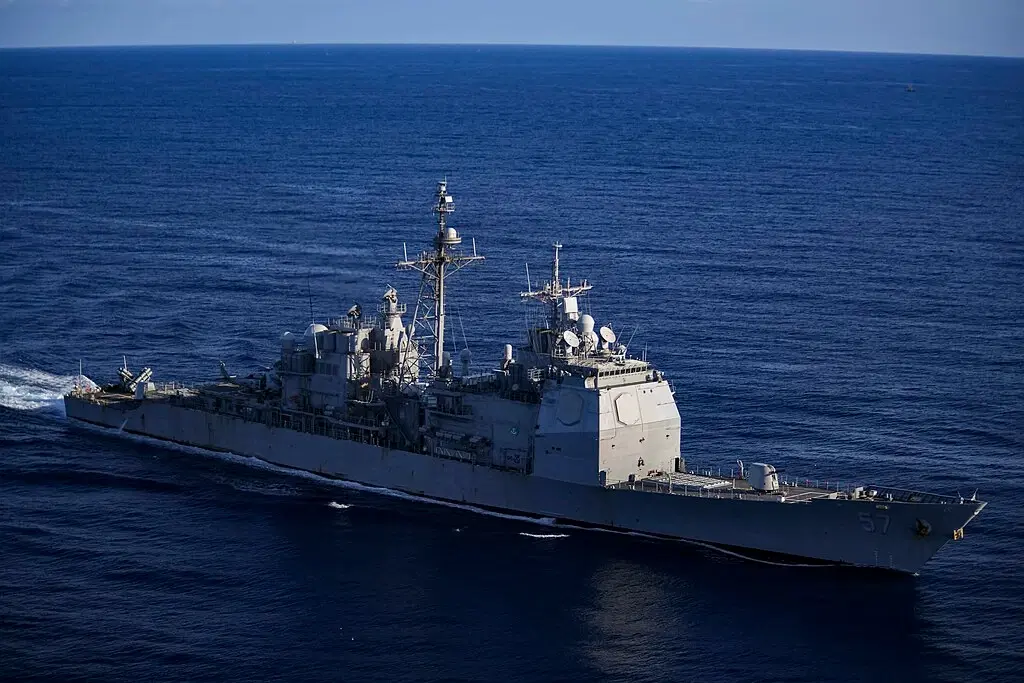
The US Navy’s move to expedite retirement of its Ticonderoga-class cruisers seems to involve a contradiction, as it is both sensible and potentially unnecessary, given that many of the warships are still viable and capable of adding value to the surface fleet.
The service has hoped to decommission its last thirteen Ticonderoga-class ships by the end of the decade or sooner by 2027 to create space for the fast-arriving Flight III Arleigh Burke-class destroyers. Some members of Congress, according to an interesting 2024 essay in The National Interest, are pushing to keep the cruisers in service for a longer period of time, arguing they bring firepower, radar and great power to the Navy’s surface fleet.
The first Ticonderoga-class ship, the USS Ticonderoga, was commissioned as far back as 1983, and the Navy has wanted to dry dock portions of the fleet to enable repairs and upgrades. Another reason may have been to reduce operating costs and the logical burden associated with keeping ships operational.
Sunset Ticonderoga Cruisers
By 1994, a total of 27 Ticonderoga-class cruisers were built, and at least 14 have already been retired. Earlier this year, an essay in The National Interest explained that four more cruisers were retired this year, the USS Vicksburg, USS Cowpens and USS Antietam and the USS Leyte Gulf. At the same time, the Navy extended the service life of three more Ticonderoga-class cruisers slated to decommission in 2026. These warships have been extended to 2029, according to a November 2024 report in Stars and Stripes. The USS Gettysburg, USS Chosin and USS Cape St. George will now operate through 2029, the paper said.
Modernization costs were cited by the Navy as a key influencer in decisions about the Ticonderoga class, along with the pace of arriving Flight III Destroyers. The reason this decision is both complex and ambiguous is because, while the cost of upgrading and modernizing the cruisers may have been prohibitive and pulled budget from other high-priority programs, it might make sense to maintain as large a fleet as possible.
Modernizing and maintaining these high-powered warships makes sense in a threat environment wherein China now operates a larger Navy than the US. Certainly quality matters as much if not more than quantity, yet the Ticonderoga-class cruisers do bring substantial additional firepower, surface warfare and anti-submarine capability to the fleet. For these reasons, it might seem to make sense to revamp and essentially “keep” a number of the warships in service.
By contrast, there is ultimately a finite amount of dollars within a surface fleet’s developmental budget, and the Navy has put 10 DDG 51 Flight III Destroyers on contract to arrive at an accelerated pace in coming years. Should an effort to modernize and maintain Ticonderoga-class cruisers impede, impair or simply weaken the Navy’s DDG 51 Flight III initiative, then it seems the ships should indeed be retired quickly.
Flight III US Navy Arleigh Burke-class destroyers definitely need to be fast-tracked to operational service as they introduce a range of cutting edge technologies. Flight III boats are the most advanced DDG 51s to ever exist, as they are built with new on-board power, cooling technology, computing, firepower and a paradigm-changing AN/SPY 1 radar. The most recent variants of Raytheon’s AN/SPY 6 radar are capable of detecting threat objects one half the size at twice the distance. The AN/SPY-6 radar, previously called Air and Missile Defense Radar, is engineered to simultaneously locate and discriminate multiple tracks. The SPY-6, as its called, is exponentially more powerful and sensitive than the AN/SPY v1 radar built into the Ticonderoga-class cruisers.
The First Flight III Destroyer to arrive was the USS Jack Lucas, a warship engineered with the paradigm-changing rear SPY-6 radar, a technology reported by Raytheon developers to be five times the strength of previous variants.
Flight IIIs also have a new software and hardware enabled ship-based radar and fire control system, called Aegis Baseline 10, will drive a new technical ability for the ship to combine air-warfare and ballistic missile defense into a single system. In an age when threats are increasingly presenting themselves at much further ranges due to advancing sensors and weapons, the much more sensitive, long-range, high-fidelity radar is critical for US Navy destroyers. Given these advantages, it might indeed be sensible for the US Navy to put its dollars and developmental energy behind the emergence of Flight III DDG 51s.
Kris Osbornis the President of Warrior Maven – Center for Military Modernization. Osborn previously served at the Pentagon as a highly qualified expert in the Office of the Assistant Secretary of the Army—Acquisition, Logistics & Technology. Osborn has also worked as an anchor and on-air military specialist at national TV networks. He has appeared as a guest military expert on Fox News, MSNBC, The Military Channel, and The History Channel. He also has a Masters Degree in Comparative Literature from Columbia University.
